
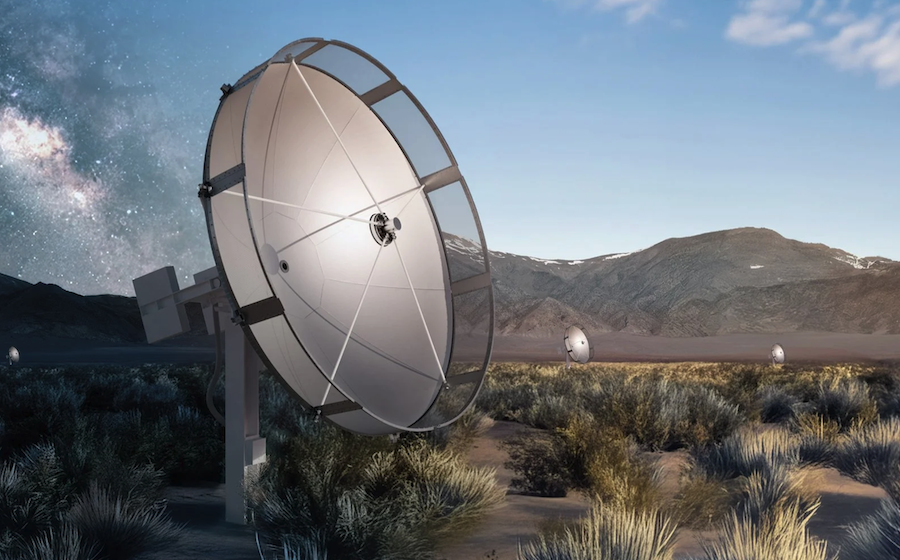
Artist's impression of one of the 6.15 metre antennas that will be built for the Deep Synoptic Array in a radio-quiet valley in Nevada
- ClientCaltech
- Data Rate34.5 Tb/s
- Bandwidth1300 MHz
- Antennas1650
View all projects
Deep Synoptic Array
Fourier Space is designing the data acquisition, data transport and system architecture for the Chronoscope instrument of the Deep Synoptic Array (DSA). DSA will be a world-leading radio survey telescope and multi-messenger discovery engine. The array will consist of 1650 × 6.15m dishes instantaneously covering the 0.7 – 2 GHz frequency range, spanning an area of 20 km × 16 km in a radio-quiet valley in Nevada. This 1650-element interferometer is being constructed by Caltech and Schmidt Sciences for a wide range of science cases.
Fourier Space is prototyping and designing solutions for the extreme data processing challenges of the Chronoscope. Each of the 1650 DSA antennas stream digitised, channelized data spanning 1300 MHz of bandwidth. The aggregate input data rate of the instrument will be over 34 Tb/s, requiring High Speed Data Acquisition to buffer voltage data streams for subsequent digital signal processing. The Chronoscope will process the digital streams using the latest tensor core powered GPUs to form millions of beams spanning the field of view. These beams will then be distributed to search algorithms via a Corner Turn that will operate at 120 Tb/s. The data will then be de-dispersed, enabling the realtime search for Pulsars and Fast Radio Bursts (FRBs).
DSA will have near complete sampling of the uv-plane, allowing the replacement of a traditional correlator digital backend with a “radio camera” that produces images in real-time. In a five-year initial survey, the DSA will image the entire viewable sky (~31,000 deg²) repeatedly over multiple epochs, with a spatial resolution of 3.0 arcseconds, detecting >1 billion radio sources in a combined full-Stokes sky map with a typical rms noise of 500 nJy/beam. As a radio survey instrument it will be unprecedented.